Subterranean termite defense in Orange County addresses the unique subterranean pressures of Central Florida, where high soil moisture and sandy soils accelerate colony expansion. In mature Orlando communities like…
Subterranean termite defense in Orange County addresses the unique subterranean pressures of Central Florida, where high soil moisture and sandy soils accelerate colony expansion. In mature Orlando communities like College Park, Delaney Park, and Thornton Park, older homes built on crawl spaces or low stem walls often encounter Reticulitermes flavipes entering through expansion joints and plumbing penetrations. In newer slab-on-grade developments across Lake Nona, Baldwin Park, and Dr. Phillips, Formosan subterranean termites utilize hyper-dense colonies capable of nesting within structural timbers once ground moisture breaches the concrete foundation. Standard store-bought repellents fail because they merely deflect subterranean workers to adjacent entry points without neutralizing the subterranean queen or central nest.
Eradication strategy requires selecting between a continuous perimeter liquid barrier and a monitored subterranean baiting network. A non-repellent liquid termiticide (such as fipronil at a 0.06% active finished dilution) binds to the sandy loam surrounding the foundation footer. Subterranean workers traverse the treated band without detection, transferring the active agent throughout the colony via grooming and trophallaxis, achieving colony collapse within 60 to 90 days. This liquid treatment is optimal for monolithic slabs with immediate, verified structural activity. Monitored bait systems, consisting of cellulose matrixes laced with insect growth regulators (such as noviflumuron), suit properties with extensive hardscaping, stone patios, or proximity to open waterways near Lake Ivanhoe or Lake Eola where soil trenching requires structural modification.
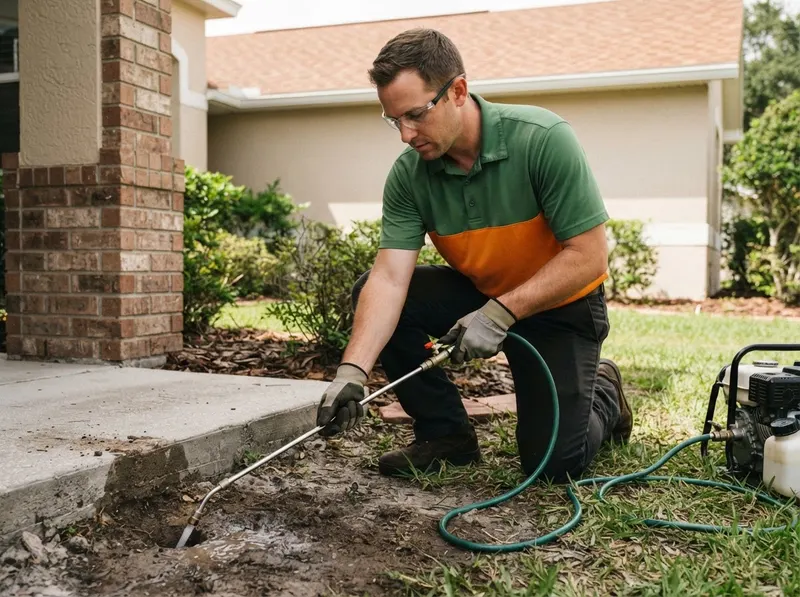
The operational sequence executes in four standardized stages. First, technicians excavate a continuous 6-inch by 6-inch trench directly against exterior foundation walls around the entire perimeter. Second, rod injection applies termiticide at a standard rate of 4 gallons per 10 linear feet per foot of depth down to the top of the footing. Third, attached concrete slabs, such as covered lanais in MetroWest or carports in Audubon Park, are drilled at 12-inch intervals along expansion joints to inject the chemical barrier below the slab. Fourth, all drilled access points are sealed with hydraulic cement matched to the masonry grade, leaving no exposed entry points for future swarmers.
Every job gets a firm, written price after a free on-site visit.
Tell us about your subterranean termite treatment job in Orlando and we'll send a clear, written quote, usually the same day.
 PestPatrol Pro