Orlando soils, characterized by sandy substrates and elevated seasonal water tables near Lake Eola Park, Lake Ivanhoe, and Lake Nona, create conditions for red imported fire ants (Solenopsis invicta) to construct…
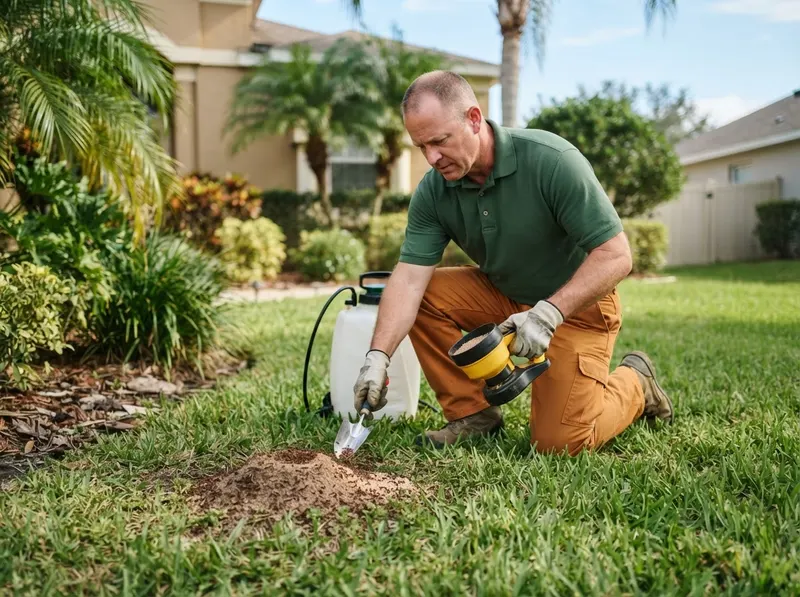
Orlando soils, characterized by sandy substrates and elevated seasonal water tables near Lake Eola Park, Lake Ivanhoe, and Lake Nona, create conditions for red imported fire ants (Solenopsis invicta) to construct interconnected subterranean colonies. Surface mounds visible after heavy subtropical downpours represent roughly 20% of a colony's subterranean network. Store-bought contact repellents scatter worker ants and trigger colony fission, wherein fertile queens relocate into adjacent flower beds or indoor wall voids. Professional yard defense utilizes specialized insect growth regulators (such as hydramethylnon or pyriproxyfen) combined with non-repellent mound drench chemistries that workers carry down to the reproductive queens before mound mortality occurs.
Properties bordering natural water retention areas or golf corridors in Dr. Phillips and MetroWest experience higher re-infestation pressure than paved urban sections in SoDo or Thornton Park. A single broadcast application controls residential turfgrass for up to six months by neutralizing active foraging zones. For high-density residential developments in Baldwin Park and Audubon Park with narrower lot lines, perimeter band applications alongside landscape curbing prevent ant displacement from neighboring yards. While contact perimeter sprays knock down visible workers immediately, systemic broadcast baits require 7 to 14 days to fully extinguish multi-queen colonies. This treatment trade-off exchanges instant surface knockdown for subterranean colony eradication that halts seasonal re-infestations.
Service execution involves a 4-step deployment: 1. Survey the property boundary, irrigation zones, and structural foundations to map active mounds and satellite foraging trails. 2. Calibrate commercial rotary spreaders to disperse granular broadcast baits across the entire lawn acreage during active foraging windows (typically early morning or late afternoon). 3. Apply non-repellent liquid injections directly into high-traffic mature mounds adjacent to patios, turf perimeters, and electrical transformer boxes. 4. Lay down a 3-foot perimeter barrier along the foundation wall to block interior migration.
Every job gets a firm, written price after a free on-site visit.
Tell us about your fire ant yard defense job in Orlando and we'll send a clear, written quote, usually the same day.
 PestPatrol Pro